
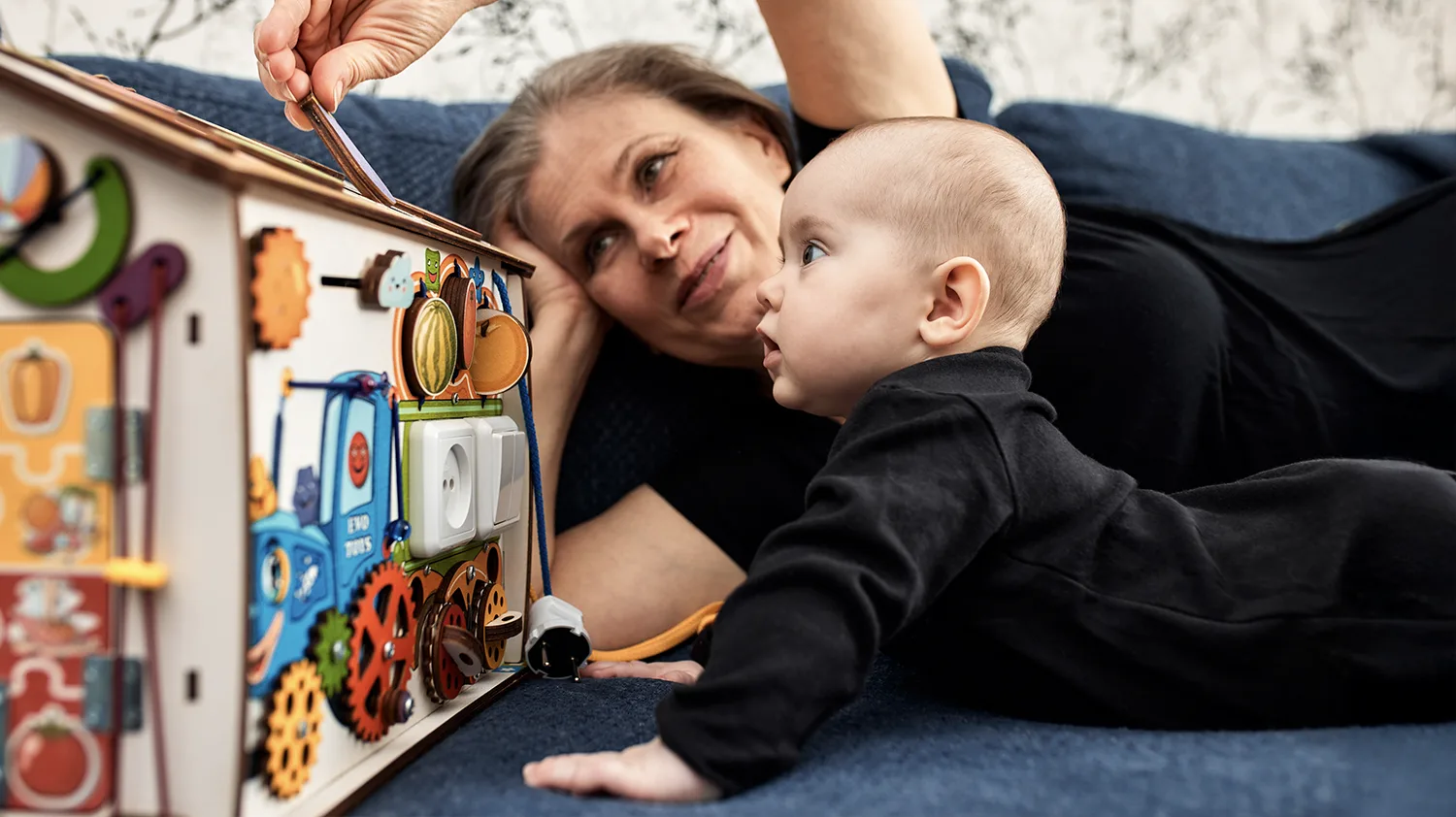
Tummy time is an important play-based learning tool for your baby. During tummy time, your tot spends time on his or her stomach under your supervision. Tummy time strengthens your child’s neck and shoulder muscles as they learn to hold up their head and shoulders and support themselves on their elbows. This muscle development and control provide the foundation your baby needs to start crawling. As their strength and coordination develop, they will move on to other movements.
Babies commonly start to pivot and rotate as they build strength and muscle control. Pivoting might involve your baby using his or her arms to turn in circles on their belly. Rotating in circles is only the beginning phase of movement. Some infants inch forward on their bellies as they attempt to crawl. Others might try crawling forward but end up pushing backwards instead. These are normal early crawling signs children exhibit as they learn how to move around.
During tummy time, infants might start planking, where they balance on their arms and feet. They might also do this on their hands and knees. When a baby starts planking, it’s one of the early signs of crawling, indicating they have developed enough strength and motor control to begin.
Babies might shift between lying prone and sitting up before learning to crawl. This movement is another sign that your infant is developing the strength and skill required to crawl.
Many babies start their forward locomotion with the belly crawl. There are two major types of belly crawling techniques. Most infants use the army crawl, also known as the commando crawl, where they balance their weight on their belly and thighs and use their arms to pull themselves forward. Their legs help somewhat as they swivel from side to side, but most of the propulsion comes from their upper body.
Some babies use the inchworm crawling technique, which varies slightly from the army crawl. Infants will pull themselves forward using only their arms, briefly balancing high on their hands before flopping forward on their bellies.
We’ve found that many babies start by rocking on their hands and knees before they begin true hands-and-knees crawling. This rocking motion is not only fun for your infant but also another one of the pre-crawling skills they’ll need to improve their balance and get moving.
Some infants might prefer the booty scoot technique, where they sit upright and use their legs to pull themselves forward, scooting along on their bottoms. This technique is common, but don’t be surprised to see your infant suddenly switch to a hands-and-knees crawl.
Before your baby starts crawling, you can encourage the transition from sitting to crawling by placing a favorite toy just out of reach and engaging them in play. The goal is to get your infant to reach for the toy and move from sitting to a hands-and-knees crawling position.
So, when do infants start to crawl on their hands and knees? We’ve found that most babies eventually end up using this classic crawling style at least some of the time. Also known as creeping, hands-and-knees crawling involves balancing on their hands and knees with their abdomens lifted off the ground.
You can expect your baby to start this classic crawling style within a few months of their starting to belly crawl or booty scoot. However, your baby doesn’t have to start with these techniques to begin hands-and-knees crawling. Some infants begin crawling on their hands and knees without any prior crawling experience.
You will see signs before your baby begins to crawl. Infants will practice balancing, often rocking back and forth on their bellies first, then on their hands and knees. Before you know it, your little one will be crawling at a speed you might not have expected, so keep an eye on your infant as they begin to explore through crawling.
Once your baby learns to crawl, the next step is cruising. This technique is a precursor to walking. Infants adept at crawling will then start pulling themselves to their feet using furniture to balance. They then walk along the edge of a coffee table or couch, leaning on it for balance.
You will likely observe them rocking or dancing on their feet while cruising, which is similar to the rocking they do on their hands and knees, as they work to improve their balance. Pay close attention, because at any moment they could take their first steps, moving from the coffee table to the couch or into Mommy and Daddy’s outstretched arms.
At our Bright Beginnings Academy daycare centers in Plymouth and Burnsville, we offer a safe and nurturing environment for your baby to grow and develop. Our carefully curated infant care program supports the cognitive, social, emotional, and physical development of babies from six weeks to 18 months old. We use music and movement, story time, and outdoor play to help develop body awareness, motor control, and early language skills. We invite you to schedule a tour of one of our Minneapolis-area schools to see how our program can help your child reach their potential.